

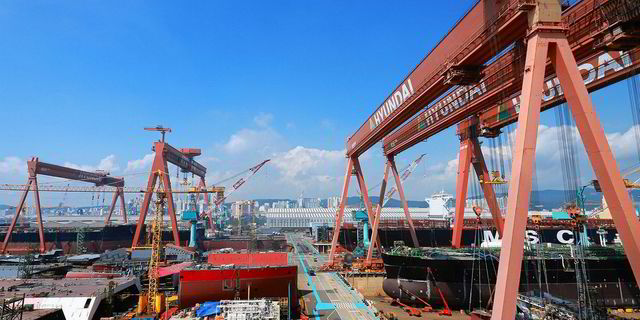
HD Hyundai Chairman Chung Ki-sun is moving to diversify the group’s production footprint as Chinese shipbuilders tighten their grip on global orders. The strategy is to concentrate high-value vessels at Korean yards while building more conventional ships at overseas bases in Vietnam, the Philippines and, most recently, India to improve price competitiveness.
A particular focus is Subic in the Philippines. HD Hyundai plans to use the site not only for commercial ships but also for locally built naval vessels, with the goal of narrowing the cost gap with China and expanding naval orders across Southeast Asia.
According to shipbuilding industry officials on Sept. 17, HD Hyundai has recently designated India as its third overseas shipbuilding base after Vietnam and the Philippines, accelerating efforts to diversify production.
The overseas push comes as global orders become increasingly concentrated in China.
According to U.K.-based shipbuilding and shipping market researcher Clarksons Research, China secured 3.59 million compensated gross tons, or 107 vessels, out of 4.2 million CGT and 125 vessels ordered worldwide in August. That gave China an 85% market share. Korea won just 310,000 CGT, or 10 vessels, for a 7% share.
For the first eight months of the year, China accounted for 45.39 million CGT, or 76% of global orders, compared with Korea’s 9.38 million CGT, or 16%. China also holds 67% of the global order backlog.
The Clarksons Newbuilding Price Index stood at 186.34 at the end of last month and continued to rise. Higher vessel prices have improved near-term profitability, but concerns are growing that Korean shipyards could face a shortage of future building volume as Chinese yards secure large amounts of work at lower prices.
Chung’s remarks at a group presidents’ meeting last month are also being interpreted as an effort to respond early to structural changes rather than become complacent during the current upcycle.
“We have painful experience of paying a harsh price after becoming obsessed with near-term results,” Chung said. “We need to lead sustainable growth with a 10- or 20-year perspective.”
HD Hyundai has therefore adopted a “split production” model that divides roles between Korea and overseas yards. Korean shipyards will focus on high-value vessels, while more conventional ships will be built overseas to narrow the cost gap with China.
The company has already tested the economics of the model through Hyundai Vietnam Shipbuilding, which builds roughly 10 ships a year. More recently, it has been pushing plans for a new yard in Tuticorin, Tamil Nadu, India, as it expands its overseas network.
At the center of the split-production strategy is the Subic shipyard in the Philippines, operated by HD Hyundai Philippines. In July, HD Hyundai launched its first 115,000-ton crude-oil tanker from the Subic yard, marking the full-scale start of commercial shipbuilding there.
Industry officials say the operating experience accumulated through commercial-vessel construction could also provide a strong foundation for HD Hyundai in the Philippine government’s naval modernization program, as Manila seeks to foster its domestic defense industry through local warship construction.
Chung met Philippine Defense Secretary Gilberto Teodoro Jr. during his visit to Korea on Sept. 7 to further develop shipbuilding and defense cooperation centered on the Subic yard.
“The Subic shipyard is an important milestone in long-term cooperation between HD Hyundai and the Philippines,” Chung said. “Beyond commercial and naval shipbuilding, we will explore opportunities for industrial cooperation in a wider range of areas.”
The Philippine side is also understood to have expressed strong support for using Subic’s infrastructure to build domestic capabilities in naval maintenance, repair and overhaul, or MRO, as well as local construction.
As the Subic yard emerges as a key base for meeting the Philippine government’s demand for “local construction and maintenance capability,” overseas defense media have also become more positive about HD Hyundai’s prospects for follow-on naval orders.
IndoPacific Report, a publication covering diplomacy and defense, recently said HD Hyundai could locally build two next-generation HDF-3200 frigates for the Philippine Navy at the Subic yard.
“This would go beyond simple vessel procurement and align with the Philippines’ national strategy of securing independent shipbuilding and maintenance capabilities,” the publication said, adding that it could help turn Subic into a core defense-production hub.
Experts say the split-production strategy is more than a labor-cost play and should be viewed as part of a broader modernization of shipbuilding processes.
“Major Korean shipyards face physical constraints in fully applying new AI- and robotics-based processes because of the way their sites are configured,” said Lee Shin-hyung, a professor of naval architecture and ocean engineering at Seoul National University. “From a long-term perspective, it may actually be more advantageous to build a new smart-production system from scratch at overseas bases such as Subic or India.”
That suggests HD Hyundai’s push for digital transformation of production processes, or AX, could be tested first at its overseas yards.
Still, the biggest practical obstacle to operating overseas bases is lower productivity caused by harsh climates combined with relatively low skill levels among local workers.
Compared with areas such as China’s Shandong Peninsula, where many major Chinese shipyards are located, Vietnam, the Philippines and India have higher temperatures and humidity throughout the year. That raises fatigue for outdoor workers and can increase welding defect rates.
Local workers also generally have less experience and lower skill levels than Korean technical staff. As a result, the man-hours required to complete the same process and the share of rework can rise significantly.
That means the cost savings from lower wages could be offset by schedule delays and weaker productivity, making sophisticated process management and systematic technology transfer to local workers critical.
“Linking local naval construction to a commercial shipyard base is a positive approach, but the real value added in a naval program comes more from internal systems and onboard equipment than from fabricating the hull itself,” Lee said.
“The key to future profitability and a lasting technology gap will be how far HD Hyundai can advance its capabilities in managing core systems beyond simple hull assembly.”
Source:insightkorea.co.kr