

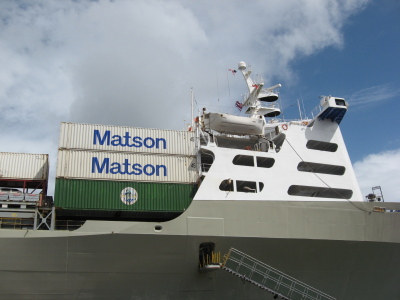
Matson, Inc., a leading U.S. carrier in the Pacific, reported net income of $143.1 million, or $4.60 per diluted share, for the quarter ended December 31, 2025. Net income for the quarter ended December 31, 2024 was $128.0 million, or $3.80 per diluted share. Consolidated revenue for the fourth quarter 2025 was $851.9 million compared with $890.3 million for the fourth quarter 2024.
Matt Cox, Matson’s Chairman and Chief Executive Officer, commented, “Matson had a solid finish to the year with consolidated fourth quarter results that exceeded our expectations. For the quarter, Ocean Transportation operating income approached the level achieved in the prior year period primarily due to higher than expected freight rates and volume in our China service driven by strong e-commerce and e-goods demand. Our China service benefited from strong freight demand in our key customer segments as well as a more stable trading environment in the Transpacific tradelane as a result of the U.S.-China trade and economic deal announced on October 30, 2025, which reduced uncertainty regarding tariffs, port entry fees, global trade and other geopolitical factors. In our domestic ocean tradelanes, we saw higher year-over-year volumes in Hawaii and Guam and lower year-over-year volume in Alaska. In Logistics, quarterly operating income decreased year-over-year primarily due to a lower contribution from supply chain management. For the full year 2025, our consolidated operating income decreased year-over-year primarily due to lower volume and freight rates in our China service over the last three quarters as customers managed freight in a challenging environment marked by uncertainty and volatility arising from tariffs and global trade.”
Mr. Cox added, “Looking ahead, we expect Ocean Transportation operating income in the first quarter 2026 to be approximately $50 million, which is lower than the first quarter last year, primarily due to lower volume in our China service. For Logistics, we expect operating income in the first quarter 2026 to be modestly lower than the level achieved in the year ago period. For full year 2026, we expect consolidated operating income to approach the level achieved in full year 2025 based on our expectations of continued solid U.S. consumer demand and a stable trading environment in the Transpacific tradelane. For 2026 compared to 2025, we also expect to see a more normal operating income seasonality pattern with our second and third quarters being the strongest relative to the first and fourth quarters.”
Fourth Quarter 2025 Discussion and Outlook for 2026
Ocean Transportation: The Company’s container volume in the Hawaii service in the fourth quarter 2025 was 0.6 percent higher year-over-year primarily due to higher general demand. Hawaii’s economy remains sluggish as softer tourism and ongoing inflationary pressures, including elevated interest rates, more than offset strength in construction activity. The Company expects volume in full year 2026 to be comparable to the level achieved in 2025, reflecting similar economic conditions and stable market share.
In China, the Company’s container volume in the fourth quarter 2025 decreased 7.2 percent year-over-year. The Company saw higher than expected freight rates and volume driven by strong e-commerce and e-goods demand. The Company benefited from strong freight demand in its key customer segments as well as a more stable trading environment in the Transpacific tradelane as a result of the U.S.-China trade and economic deal announced on October 30, 2025, which reduced uncertainty regarding tariffs, port entry fees, global trade and other geopolitical factors. In the first quarter 2026, the Company expects lower volume compared to the prior year period. The Company expects volume in full year 2026 to be modestly higher than the level achieved in 2025 based on our expectations of continued solid U.S. consumer demand and a stable trading environment in the Transpacific tradelane.
In Guam, the Company’s container volume in the fourth quarter 2025 increased 4.4 percent year-over-year primarily due to higher general demand. In the near term, the Company expects Guam’s economy to moderate reflecting a challenging tourism environment. For full year 2026, the Company expects volume to be comparable to the level achieved last year.
In Alaska, the Company’s container volume for the fourth quarter 2025 decreased 3.3 percent year-over-year. The decrease was primarily due to one less northbound sailing compared to the year ago period, partially offset by higher export seafood volume on AAX. In the near term, the Company expects continued economic growth in Alaska supported by a low unemployment rate, jobs growth and continued oil and gas exploration and production activity. For full year 2026, the Company expects volume to be comparable to the level achieved last year.
The contribution in the fourth quarter 2025 from the Company’s SSAT joint venture investment was $9.3 million, or $18.8 million higher than fourth quarter 2024. The increase was primarily due to an impairment charge related to the write-down of a terminal operating lease asset at SSAT which impacted fourth quarter 2024 operating income, net income and diluted earnings per share by $18.4 million, $14.0 million and $0.42 per share, respectively. For full year 2026, the Company expects the contribution from SSAT to be comparable to the $32.5 million achieved in full year 2025.
Based on the outlook trends noted above, the Company expects Ocean Transportation operating income for the first quarter 2026 to be approximately $50 million. For full year 2026, the Company expects Ocean Transportation operating income to approach the level achieved in full year 2025. For 2026 compared to 2025, the Company also expects to see a more normal operating income seasonality pattern with second and third quarters being the strongest relative to the first and fourth quarters.
Logistics: In the fourth quarter 2025, operating income for the Company’s Logistics segment was $7.7 million, or $2.4 million lower compared to the level achieved in the fourth quarter 2024. The decrease was primarily due to a lower contribution from supply chain management. For the first quarter 2026, the Company expects Logistics operating income to be modestly lower than the $8.5 million achieved in the first quarter 2025. For full year 2026, the Company expects Logistics operating income to approach the $44.2 million achieved in full year 2025.
Consolidated Operating Income: For the first quarter 2026, the Company expects consolidated operating income to be lower than the $82.1 million achieved in the first quarter 2025. For full year 2026, the Company expects consolidated operating income to approach the level achieved in full year 2025 based on our expectations of continued solid U.S. consumer demand and a stable trading environment.
Depreciation and Amortization: For full year 2026, the Company expects depreciation and amortization expense to be approximately $210 million, inclusive of dry-docking amortization of approximately $35 million.
Interest Income: The Company expects interest income for the full year 2026 to be approximately $15 million.
Interest Expense: The Company expects interest expense for the full year 2026 to be approximately $6 million.
Other Income (Expense): The Company expects full year 2026 other income (expense) to be approximately $7 million in income, which is attributable to the amortization of certain components of net periodic benefit costs or gains related to the Company’s pension and post-retirement plans.
Income Taxes: In the fourth quarter 2025, the Company’s effective tax rate was 5.2 percent and benefited from a one-time tax adjustment of $18.5 million, or $0.59 per share, related to the Company’s deferred tax assets and liabilities. For the full year 2025, the Company’s effective tax rate was 16.7 percent. For the full year 2026, the Company expects its effective tax rate to be approximately 21.0 percent.
Capital and Vessel Dry-docking Expenditures: For the full year 2025, the Company made capital expenditure payments excluding new vessel construction expenditures of $149.1 million, new vessel construction expenditures (including capitalized interest and owner’s items) of $244.3 million, and dry-docking payments of $49.4 million. For the full year 2026, the Company expects to make other capital expenditure payments, including maintenance capital expenditures, of approximately $150 to $170 million, new vessel construction expenditures (including capitalized interest and owner’s items) of approximately $425 million, and dry-docking payments of approximately $45 million.
| Results By Segment | ||||||||||||
| Ocean Transportation — Three months ended December 31, 2025 compared with 2024 | ||||||||||||
| Three Months Ended December 31, | ||||||||||||
| (Dollars in millions) | 2025 | 2024 | Change | |||||||||
| Ocean Transportation revenue | $ | 704.2 | $ | 742.1 | $ | (37.9) | (5.1) | % | ||||
| Operating costs and expenses | (568.2) | (604.7) | 36.5 | (6.0) | % | |||||||
| Operating income | $ | 136.0 | $ | 137.4 | $ | (1.4) | (1.0) | % | ||||
| Operating income margin | 19.3 | % | 18.5 | % | ||||||||
| Volume (Forty-foot equivalent units (FEU)) (1) | ||||||||||||
| Hawaii containers | 35,000 | 34,800 | 200 | 0.6 | % | |||||||
| Alaska containers | 17,400 | 18,000 | (600) | (3.3) | % | |||||||
| China containers (2) | 34,700 | 37,400 | (2,700) | (7.2) | % | |||||||
| Guam containers | 4,700 | 4,500 | 200 | 4.4 | % | |||||||
| Other containers (3) | 4,800 | 4,300 | 500 | 11.6 | % | |||||||
| (1) | Approximate volume included for the period are based on the voyage departure date, but revenue and operating income are adjusted to reflect the percentage of revenue and operating income earned during the reporting period for voyages in transit at the end of each reporting period. |
| (2) | Includes containers from China and other Asia origins. |
| (3) | Includes containers from services in various islands in Micronesia and the South Pacific, and Okinawa, Japan. |
Ocean Transportation revenue decreased $37.9 million, or 5.1 percent, during the three months ended December 31, 2025, compared with the three months ended December 31, 2024. The decrease was primarily due to lower freight rates and volume in China.
On a year-over-year FEU basis, Hawaii container volume increased 0.6 percent primarily due to higher general demand; Alaska volume decreased 3.3 percent primarily due to one less northbound sailing compared to the year ago period, partially offset by higher export seafood volume on AAX; China volume was 7.2 percent lower; Guam volume increased 4.4 percent primarily due to higher general demand; and Other containers volume increased 11.6 percent.
Ocean Transportation operating income decreased $1.4 million, or 1.0 percent, during the three months ended December 31, 2025, compared with the three months ended December 31, 2024. The decrease was primarily due to a lower contribution from China, partially offset by a higher contribution from SSAT.
The Company’s SSAT terminal joint venture investment contributed $9.3 million during the three months ended December 31, 2025, compared to a loss of $9.5 million during the three months ended December 31, 2024. The increase was primarily due to an impairment charge related to the write-down of a terminal operating lease asset at SSAT in the year ago period which impacted operating income by $18.4 million.
| Ocean Transportation — Year ended December 31, 2025 compared with 2024 | ||||||||||||
| Years Ended December 31, | ||||||||||||
| (Dollars in millions) | 2025 | 2024 | Change | |||||||||
| Ocean Transportation revenue | $ | 2,735.5 | $ | 2,809.7 | $ | (74.2) | (2.6) | % | ||||
| Operating costs and expenses | (2,279.9) | (2,308.8) | 28.9 | (1.3) | % | |||||||
| Operating income | $ | 455.6 | $ | 500.9 | $ | (45.3) | (9.0) | % | ||||
| Operating income margin | 16.7 | % | 17.8 | % | ||||||||
| Volume (Forty-foot equivalent units (FEU)) (1) | ||||||||||||
| Hawaii containers | 143,000 | 140,700 | 2,300 | 1.6 | % | |||||||
| Alaska containers | 81,900 | 80,500 | 1,400 | 1.7 | % | |||||||
| China containers (2) | 130,400 | 144,100 | (13,700) | (9.5) | % | |||||||
| Guam containers | 18,000 | 18,800 | (800) | (4.3) | % | |||||||
| Other containers (3) | 17,200 | 17,000 | 200 | 1.2 | % | |||||||
| (1) | Approximate volume included for the period are based on the voyage departure date, but revenue and operating income are adjusted to reflect the percentage of revenue and operating income earned during the reporting period for voyages in transit at the end of each reporting period. |
| (2) | Includes containers from China and other Asia origins. |
| (3) | Includes containers from services in various islands in Micronesia and the South Pacific, and Okinawa, Japan. |
Ocean Transportation revenue decreased $74.2 million, or 2.6 percent, during the year ended December 31, 2025, compared with the year ended December 31, 2024. The decrease was primarily due to lower volume in China.
On a year-over-year FEU basis, Hawaii container volume increased 1.6 percent primarily due to higher general demand and the dry-docking of a competitor’s vessel in the first half of 2025; Alaska volume increased 1.7 percent primarily due to higher export seafood volume on AAX, partially offset by one less northbound sailing; China volume decreased 9.5 percent primarily due to the difficult trading environment in the Transpacific in the last three quarters of 2025 marked by continued uncertainty and volatility arising from tariffs and global trade; Guam volume decreased 4.3 percent primarily due to lower general demand; and Other containers volume increased 1.2 percent.
Ocean Transportation operating income decreased $45.3 million, or 9.0 percent, during the year ended December 31, 2025, compared with the year ended December 31, 2024. The decrease was primarily due to a lower contribution from China, partially offset by a higher contribution from SSAT.
The Company’s SSAT terminal joint venture investment contributed $32.5 million during the year ended December 31, 2025, compared to a loss of $1.0 million during the year ended December 31, 2024. The increase was primarily due to an impairment charge related to the write-down of a terminal operating lease asset at SSAT in the year ago period which impacted operating income by $18.4 million and higher lift volume.
| Logistics — Three months ended December 31, 2025 compared with 2024 | ||||||||||||
| Three Months Ended December 31, | ||||||||||||
| (Dollars in millions) | 2025 | 2024 | Change | |||||||||
| Logistics revenue | $ | 147.7 | $ | 148.2 | $ | (0.5) | (0.3) | % | ||||
| Operating costs and expenses | (140.0) | (138.1) | (1.9) | 1.4 | % | |||||||
| Operating income | $ | 7.7 | $ | 10.1 | $ | (2.4) | (23.8) | % | ||||
| Operating income margin | 5.2 | % | 6.8 | % | ||||||||
Logistics revenue decreased $0.5 million, or 0.3 percent, during the three months ended December 31, 2025, compared with the three months ended December 31, 2024. The decrease was primarily due to lower revenue in supply chain management, partially offset by higher revenue in transportation brokerage.
Logistics operating income decreased $2.4 million, or 23.8 percent, during the three months ended December 31, 2025, compared with the three months ended December 31, 2024. The decrease was primarily due to a lower contribution from supply chain management.
| Logistics — Year ended December 31, 2025 compared with 2024 | ||||||||||||
| Years Ended December 31, | ||||||||||||
| (Dollars in millions) | 2025 | 2024 | Change | |||||||||
| Logistics revenue | $ | 609.0 | $ | 612.1 | $ | (3.1) | (0.5) | % | ||||
| Operating costs and expenses | (564.8) | (561.7) | (3.1) | 0.6 | % | |||||||
| Operating income | $ | 44.2 | $ | 50.4 | $ | (6.2) | (12.3) | % | ||||
| Operating income margin | 7.3 | % | 8.2 | % | ||||||||
Logistics revenue decreased $3.1 million, or 0.5 percent, during the year ended December 31, 2025, compared with the year ended December 31, 2024. The decrease was primarily due to lower revenue in transportation brokerage and supply chain management, partially offset by higher revenue in freight forwarding.
Logistics operating income decreased $6.2 million, or 12.3 percent, during the year ended December 31, 2025, compared with the year ended December 31, 2024. The decrease was primarily due to lower contributions from freight forwarding and transportation brokerage.
Liquidity, Cash Flows and Capital Allocation
Matson’s Cash and Cash Equivalents decreased by $124.9 million from $266.8 million at December 31, 2024 to $141.9 million at December 31, 2025. As of December 31, 2025, there was $532.7 million of cash and cash equivalents and investments in fixed-rate U.S. Treasuries in the Capital Construction Fund. Matson generated net cash from operating activities of $547.1 million during the year ended December 31, 2025, compared to $767.8 million during the year ended December 31, 2024. The year-over-year decline in net cash from operating activities was due primarily to the receipt of a federal tax refund of $118.6 million in the second quarter 2024 related to the Company’s 2021 federal tax return. Capital expenditures (including capitalized vessel construction expenditures) totaled $393.4 million for the year ended December 31, 2025, compared with $310.1 million for the year ended December 31, 2024. Total debt decreased by $39.7 million during the year to $361.2 million as of December 31, 2025, of which $321.5 million was classified as long-term debt.1 As of December 31, 2025, Matson had available borrowings under its revolving credit facility of $544.3 million.
During the fourth quarter 2025, Matson repurchased approximately 0.7 million shares for a total cost of $78.1 million.2 As of December 31, 2025, there were approximately 1.1 million shares remaining in the Company’s share repurchase program. Matson’s Board of Directors also declared a cash dividend of $0.36 per share payable on March 5, 2026 to all shareholders of record as of the close of business on February 5, 2026.