

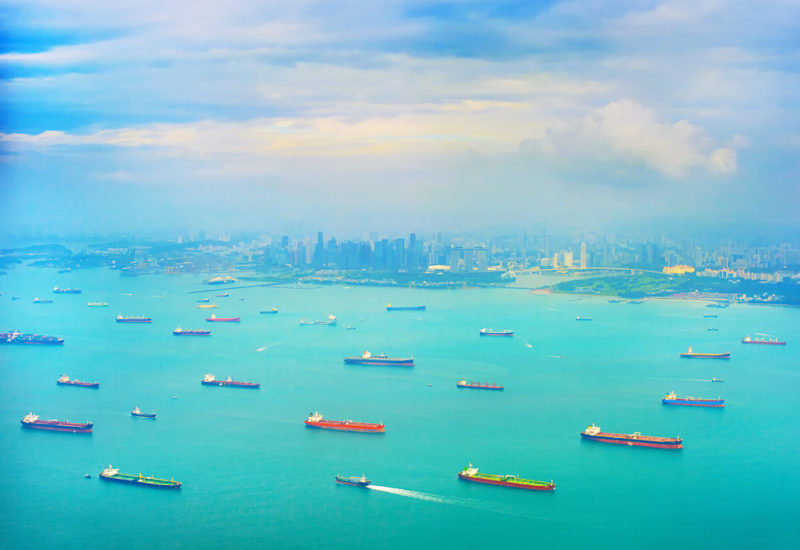
For decades, global trade rested on an almost self-evident assumption: commercial vessels could move freely across the seas, even when relations between states came under strain.
That assumption is now being called into question. In an exceptionally rare – and therefore significant – intervention, 18 of the world’s leading shipping nations, including Greece, are warning that the rules on which international maritime trade was built are beginning to break down. Wars, attacks on commercial vessels, the struggle for control of critical maritime chokepoints and the expansion of the so-called “shadow fleet” are not creating another temporary crisis but a “structural change in the operating environment of global trade”.
Since more than 80% of global trade is transported by sea, the warning extends far beyond the shipping industry.
The first public intervention in more than 60 years
The warning comes from the Consultative Shipping Group (CSG), whose members account for more than one-fifth of global trade by shipping capacity. The group includes Greece, Singapore, Denmark, Japan, Canada, the United Kingdom, the Netherlands and South Korea, among others.
The significance of the move is considerable: according to the Financial Times, this is the CSG’s first public intervention since it was established more than 60 years ago.
“Without maritime trade, supply chains would fragment and the global economy as we know it would grind to an abrupt halt,” the 18 countries warned.
From “free seas” to the geopolitics of chokepoints
At the heart of the problem lies a centuries-old principle: freedom of navigation.
The modern maritime trading system was built on the neutrality of commercial vessels and international rules allowing them to move relatively freely between states and continents.
The concept of “freedom of the seas” – mare liberum – dates back to the 17th century, while today the international regulatory framework governing shipping is shaped to a large extent through the International Maritime Organization (IMO).
It is precisely this framework that is now coming under pressure.
“For decades, we built global trade on the assumption that ships could move freely across borders. That assumption is now being tested,” Brian Vessel, director-general of the Danish Maritime Authority, which chairs the CSG, told the Financial Times.
Hormuz becomes the major test
Nowhere is this shift more evident than in the Strait of Hormuz. Tehran announced on Monday that it was close to an agreement with Oman on managing navigation through the waterway, through which around one-fifth of global oil and gas supplies passed before the war.
It is not yet clear whether the agreement will include a transit fee. But the prospect alone is causing serious concern in the shipping industry.
Shipowners and shipping organisations fear that imposing tolls on such a critical international waterway could set a dangerous precedent. If one country gains the ability to turn a global chokepoint into a tool of economic or geopolitical pressure, other countries controlling similar passages could seek to do the same.
The CSG sums it up in one phrase: sea lanes are increasingly becoming “tools of leverage and risk”.
Commercial vessels are shifting from neutral assets to targets
The events of 2026 have made this shift even more apparent.
Russia, Ukraine, the US and Iran have struck civilian shipping targets as part of ongoing conflicts, with commercial vessels increasingly caught at the centre of geopolitical confrontations.
The cost is not limited to the immediate impact of an attack. It triggers a chain reaction: higher insurance premiums, increased freight rates, route changes, longer transit times and, ultimately, higher prices for businesses and consumers.
The message from the shipping nations is that incidents once treated as exceptions are increasingly taking on the characteristics of a new normal.
The “shadow fleet” has reached 1,500 tankers
The second major threat is less dramatic than a missile attack on a vessel, but potentially just as serious for the international shipping system.
US, EU and UK sanctions against Russia and Iran have contributed to the rapid expansion of a vast “shadow fleet” of tankers operating largely outside the traditional Western system of oversight, insurance and financing.
According to data from TankerTrackers.com cited by the Financial Times, the fleet now numbers more than 1,500 vessels – almost one-fifth of the global tanker fleet.
Almost all operate without the traditional insurance cover used in international shipping.
And this raises a risk that goes beyond sanctions or geopolitics: who pays when something goes wrong?
The 800,000-barrel tanker that hit a mine
The question became highly tangible this summer.
The Caroline Bezengi, a shadow-fleet vessel carrying around 800,000 barrels of Russian oil, struck a moored mine off the coast of Oman.
The vessel did not have the traditional protection and indemnity (P&I) insurance cover used in international shipping.
This means that in the event of major pollution, the cost of clean-up and dealing with the consequences – potentially running into millions of dollars – could ultimately fall on the Omani state.
It is perhaps the clearest example of the problem described by the 18 shipping nations: when a large number of vessels operate outside the traditional system of rules, oversight and insurance, the risk does not disappear. It is simply transferred elsewhere.
Why the warning concerns the entire global economy
The pandemic demonstrated how easily global supply chains can be disrupted. The wars that followed added new risks. Hormuz is now showing how powerful a geopolitical weapon a maritime chokepoint can become, while the shadow fleet is creating a parallel shipping system governed by different rules and with far fewer safeguards.
That is why the 18 countries insist that these are not a series of separate, isolated shocks.
Their concern is deeper: global shipping is moving from a system based on commonly accepted rules towards a more fragmented environment, in which sea lanes, vessels and critical chokepoints are becoming part of geopolitical confrontation.
And for an economy in which more than 80% of global trade travels by sea, the erosion of the rules governing the seas is not simply a shipping problem. It is a problem for the way global trade itself operates.
Source: Naftemporiki