

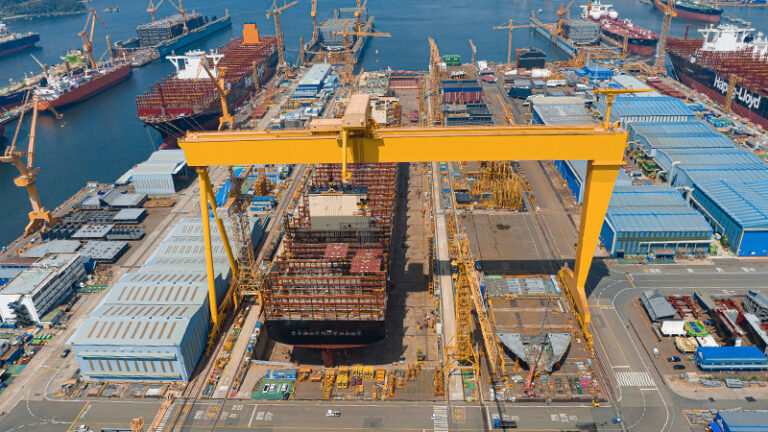
Driven by the promotion of ‘MASGA,’ a South Korea-United States shipbuilding cooperation project, and a rapid surge in demand for high value-added ships, the domestic shipbuilding industry has entered an unprecedented boom, but it is suffering growing pains due to a heat difference between labor and management over the distribution of performance.
With several years’ worth of work secured, the positions of the labor unions demanding the fruits of the boom and the management arguing for increased investments to prepare for a future downturn are in conflict, amid which Samsung Heavy Industries became the first among the shipbuilding ‘Big 3’ to settle its wage negotiations and conclude bargaining.
According to the shipbuilding industry on Sept. 23, the labor and management of Samsung Heavy Industries conducted a union member vote on the tentative agreement for this year’s wage negotiations and led to its final approval with an approval rate of 58.78%. Through this agreement, Samsung Heavy Industries decided to increase the basic wage by 5.2% (131,786 won or $97.61 per month), including the regular step-up increment, and to pay an encouragement bonus totaling 7,000,000 won.
In particular, the standard for calculating the Excess Profit Incentive (OPI), which was a core issue of contention, was reorganized from 20% of the existing Economic Value Added (EVA) to 10% of operating profit, thereby increasing the transparency of performance distribution. As Samsung Heavy Industries completed the negotiations first, it is expected that the subsequent improvement of earnings and the establishment of a foundation for labor-management coexistence will gain momentum.
On the other hand, Hanwha Ocean and HD Hyundai Heavy Industries are still running parallel lines over the calculation standard and the increase range of the performance bonus.
The labor and management of Hanwha Ocean held their 24th negotiation on Sept. 22 but failed to reach an agreement. While the union is demanding a basic wage increase of 149,600 won, an expansion of bonuses, and the stipulation of the performance bonus payment standard in writing, the management clashed by proposing the establishment of a task force (TF) to improve the performance bonus system. As the union successively halted the operation of key cranes within the workplace, including the Goliath crane, warning signals are growing louder that disruptions may accumulate in subsequent construction processes such as block mounting.
HD Hyundai Heavy Industries is also raising the intensity of its strike, continuing a strong-vs-strong standoff. The management submitted a third proposal containing a basic wage increase of 110,000 won and a payment of a 10 million won encouragement bonus plus 200%, but the union rejected it. The union is demanding a basic wage increase of 149,600 won and a 30% distribution of operating profit, and has announced a full-scale struggle, including a joint strike with the shipbuilding industry union solidarity after the Chuseok holidays.
The industry is concerned that if production disruptions are prolonged at a time when unprecedented order backlogs have been accumulated, cost burdens, such as the occurrence of liquidated damages for delay caused by delayed construction schedules, will increase.
In particular, it is pointed out that if production disruptions caused by strikes are repeated during a critical turning point when South Korea and the United States are trying to strengthen strategic cooperation in the shipbuilding and defense sectors, not only could the external reliability of domestic shipyards decline, but the driving force of major defense and export projects could also weaken. Attention is being paid to how the news of Samsung Heavy Industries’ sudden settlement will affect the labor-management negotiations of other companies that have entered a prolonged phase.
Source: Business Korea