

Navios Maritime Partners L.P. reported financial results for the first quarter ended March 31, 2026.
- Revenue:
$357.0 million for Q1 2026
- Net income:
$106.3 million for Q1 2026
- Earnings per common unit:
$3.64 for Q1 2026
- Net cash from operating activities:
$126.6 million for Q1 2026
- EBITDA:
$212.7 million for Q1 2026
- Returning capital to unitholders:
1,759,769 common units repurchased in 2024 – 2026 (through May 15) for $83.6 million
240,502 common units repurchased in 2026 (through May 15) for $15.6 million
$0.06 cash distribution per unit for Q1 2026; $0.24 per unit annualized for 2026
- Sales and purchases in 2026 YTD:
$616.3 million acquisition cost of six newbuilding scrubber-fitted vessels
$482.0 million for four VLCC tankers
$134.3 million for two capesize vessels
$189.3 million gross sale proceeds from the sale of five vessels; average age of 17.0 years
$136.5 million from two VLCC tankers
$ 30.0 million from a 4,730 TEU containership
$ 22.8 million from two dry bulk vessels
- Five newbuilding vessels delivered
$4.1 billion contracted revenue as of May 2026
Navios Maritime Partners L.P., an international owner and operator of dry cargo and tanker vessels, today reported its financial results for the first quarter ended March 31, 2026.
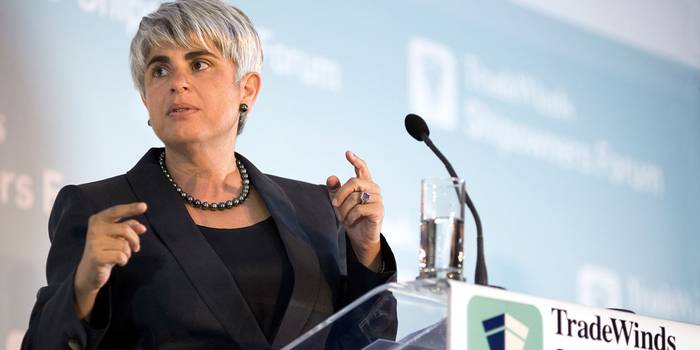
Angeliki Frangou, Chairwoman and Chief Executive Officer of Navios Partners stated, “I am pleased with the results for the first quarter of 2026 in which we reported net income of $106.3 million and EBITDA of $212.7 million. Earnings per common unit were $3.64 for the quarter, and we announced a $0.06 cash distribution per unit for the quarter.”
Angeliki Frangou continued, “We are witnessing the emergence of a new world order – one in which trade is used as an instrument of national policy. National security considerations are increasingly central to the decision-making process, and governments are asserting greater control over strategic supply chains. The Iranian conflict underscores this shift. It also focused global awareness on the critical importance of the Strait of Hormuz, a vital artery for the movement of essential commodities – from LNG and crude oil to refined products and fertilizers. We expect this conflict to have lasting implications on trade, as countries and companies diversify supply routes to safer areas. It is too early to assess the long-term impact, and we are monitoring developments closely.”