

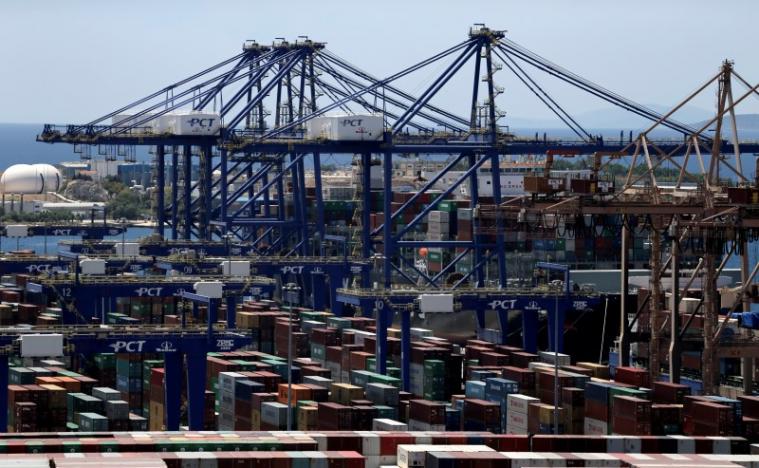
The Piraeus Container Terminal (PCT) Sustainability Report recorded a 12% improvement in financial performance, despite a 5.95% decline in container throughput, highlighting progress in efficiency, digitalisation, safety, human resources and environmental performance.
The decline in throughput is attributed to the challenging international and operating environment caused by geopolitical turmoil and disruptions to supply chains. Despite these pressures, PCT managed to increase its revenue by capitalising on pricing dynamics, cost control and the optimisation of terminal operations.
Revenue growth
This is also reflected in the financial results, with revenue rising 12% to €317.9 million from €282.7 million in 2024, despite a 5.95% decline in container throughput.
EBITDA stood at €94.1 million, while net profit rose to €36.1 million from €26.6 million a year earlier. “We continue to strengthen our role as a key gateway for global trade and a strategic driver of regional economic growth,” PCT CEO Chen Dong said in his message, stressing that the company is seeking to combine financial performance with efficiency and sustainability.
More efficient operations
The report’s key message is that PCT is shifting the focus of its growth strategy away from simply increasing volumes towards a model based on greater efficiency, tighter cost control, digitalisation and better utilisation of its infrastructure and equipment.
The company links the improvement in operational performance to automation and digital management, noting that the average task completion time fell by 2.77%.
PCT, a wholly owned subsidiary of COSCO SHIPPING Ports Limited, operates Terminals II and III at the Port of Piraeus under a 35-year concession agreement that began in 2009.
Investments made in previous years have increased the facilities’ capacity from around 1.6 million TEUs to 6.2 million TEUs, strengthening Piraeus’ role as a transshipment hub connecting Asia with Europe, the Mediterranean and the Black Sea.
Particular emphasis in the report is also placed on environmental performance. The company’s total greenhouse gas emissions in 2025 amounted to 57,627 tonnes of CO2e, with direct emissions standing at 13,825.82 tonnes, indirect emissions from electricity consumption at 12,655.80 tonnes, and value chain emissions at 31,145.81 tonnes.
The latter figure is particularly significant, as it shows that more than half of the company’s total carbon footprint, approximately 54%, is now linked to activities outside its direct operational control.
According to the report, total emissions fell by 3.94%, while electricity consumption declined by 3.33% to 46.06 million kWh.
However, as TEU throughput declined at a faster rate, electricity consumption per TEU increased by 2.79%, highlighting a less favourable aspect of energy efficiency.
Even more striking is the progress towards the company’s decarbonisation targets. PCT has set a target of reducing emissions by 30% until 2030, while Category 1 and 2 emissions were already 35.24% below the 2022 baseline in 2025.
The company said that it has already exceeded its 2030 target, while maintaining its longer-term goal of a 60% reduction by 2040 and climate neutrality by 2050.
Significant progress was also recorded in water management. Total consumption fell by 21.21%, from 128.91 ML to 101.57 ML, while consumption at the terminal alone declined by 38.32%.
At the same time, total waste generated fell by 17.01%, although non-hazardous waste increased, indicating that performance was not uniform across all environmental indicators.
Social Initiatives
On the social front, PCT employed 349 people in 2025, compared with 348 in 2024. The number of women increased to 57 from 55, accounting for 16.3% of the workforce.
Meanwhile, total training hours increased by 44.5% to 10,142, while average training hours per FTE rose from 20.28 to 29.37.
It is also worth noting that DPort Services, PCT’s key partner for the operation of Terminals II and III, has reported a workforce exceeding 2,000 jobs.
In health and safety, the company reported that no work-related accidents with serious consequences were recorded in 2025, while lost working days due to recorded accidents fell by around 41%.
At the same time, preparations continued for ISO 45001 certification, alongside the development of an electronic Permit-to-Work system.
PCT’s social footprint also extended beyond its facilities. The company allocated more than €140,000 to corporate social responsibility initiatives, including five scholarships worth €4,000 each and around €22,000 to support schools in Perama and Keratsini.
At the governance level, the report recorded zero incidents of corruption or breaches of business ethics, while 444 participants took part in training on corporate governance, business ethics and regulatory compliance.
Source: Naftemporiki