

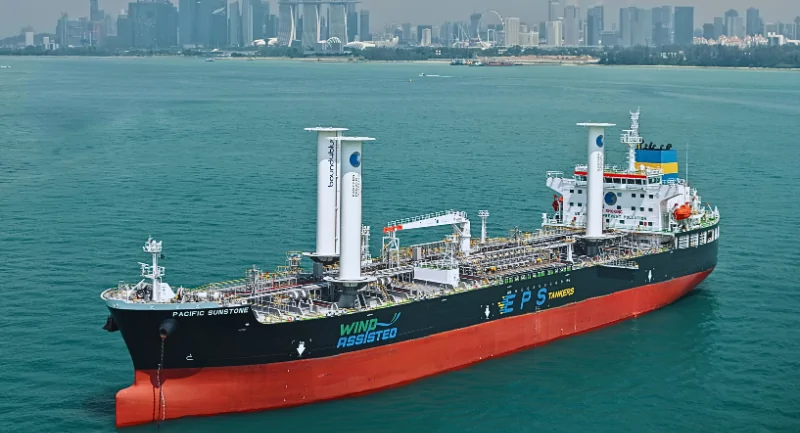
Singapore-based Eastern Pacific Shipping (EPS) marks Singapore Maritime Week (SMW) with the maiden voyage of its MR tanker Pacific Sunstone to Singapore, underscoring the city-state’s role as a global hub for maritime innovation and decarbonisation.
Fresh from delivery at New Times Shipbuilding in China, Pacific Sunstone is equipped with three 22-metre bound4blue eSAIL® suction sails, marking EPS’ second deployment of wind-assisted propulsion technology and its first integration on a newbuild vessel.
The vessel’s arrival highlights Singapore’s position at the forefront of maritime decarbonisation, where collaboration across industry continues to accelerate the adoption of practical, scalable solutions. EPS’ investment in wind-assisted propulsion complements broader progress across the sector, including advancements in alternative fuels and initiatives that support greener operations, such as its collaboration with Singapore-based Yinson GreenTech’s marinEV on electric vessel trials.
“Singapore continues to play a leading role in shaping the future of sustainable shipping, and we are proud to support this progress. The arrival of Pacific Sunstone during Singapore Maritime Week reflects the strength of the ecosystem here — where owners, technology providers and partners come together to advance practical decarbonisation solutions,” said Cyril Ducau, Chief Executive Officer of EPS.
“At EPS, we are focused on deploying technologies that deliver real operational benefits. Wind-assisted propulsion is one such solution, offering measurable fuel savings while supporting our long-term sustainability ambitions,” adds Cyril. The installation builds on EPS’ earlier retrofit of eSAILs® on Pacific Sentinel, where a joint study with the Global Centre for Maritime Decarbonisation (GCMD) confirmed measurable fuel and power savings.
By integrating the system during construction, Pacific Sunstone demonstrates how wind-assisted propulsion can be deployed efficiently across both retrofit and newbuild programmes. This builds on EPS’ broader decarbonisation efforts across multiple pathways — from advancing alternative fuels such as LNG, biofuels and ammonia, to deploying wind-assisted propulsion systems that enhance operational efficiency.
The six-month study onboard Pacific Sentinel, conducted with GCMD using high-frequency data collection and on–off testing, recorded an average net power reduction of 8.0% and net fuel savings of 5.5%, with peak savings exceeding 20% under favourable wind conditions — supporting improved vessel efficiency and competitiveness alongside emissions reduction. As Singapore hosts industry leaders for SMW, the vessel’s maiden call serves as a timely example of how innovation is being translated into real-world deployment at scale.