

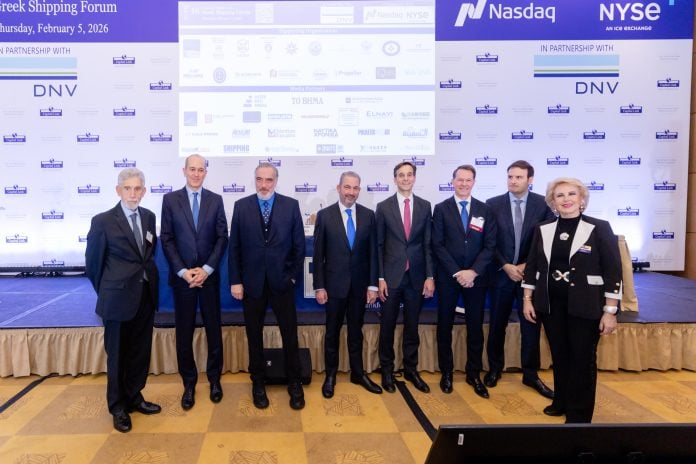
Greek shipowners and entrepreneurs are leading the way in developing maritime corridors that will transport energy products from the US to Europe.
The founder and CEO of Tsakos Energy Navigation, Dr. Nikos Tsakos, underlined the importance that the US government places on shipping.
Speaking at the 16th Capital Link Maritime Conference in Greece, Tsakos stressed that the current US administration has, from the very beginning, paid special attention to maritime transport.
Recognition
“In the past”, he added, “the authorities considered shipping as a necessary evil, without particularly appreciating the fact that it transports the goods and energy that the entire planet needs”.
“But,” he added, “finally, the role of shipping seems to be recognized. We are also open to collaborations with US companies, such as Exxon, which have been our customers and partners for many years.”
Referring to liquefied natural gas, he also highlighted the issues facing the shipping industry.
“Ships are built faster than infrastructure. This is an issue that we must address as shipowners. It takes two years to build a ship, but the legislation and government approvals required for infrastructure projects delay the process,” he stressed, adding:
“If we join forces and focus on reducing methane leaks, instead of wasting time on exotic ideas that may prove unrealistic, things would be even better.”
Οn his part, Alexandros Exarchou, Chairman and CEO of AKTOR Group of Companies and CEO of Atlantic See LNG Trade, noted: “The Vertical Corridor is an important project for many countries, as the war in Ukraine has made it clear that energy dependence creates problems.
The EU now has no access to natural gas pipelines, following the ban on the transit of Russian natural gas from January 1, 2026, and with limited production capacity in Azerbaijan.
The different sources of LNG include not only the USA, but also Qatar and Australia.
I believe that LNG consumption will continue to increase in the foreseeable future. The entire market in Europe will change.”
Regarding the challenges, Exarchou noted: “The problem with the current infrastructure in Greece is that the FSRUs and pipelines are clearly not able to cope with the quantities that will be needed. They will need to be improved.
Shipowners are already buying more LNG carriers and some additional pipelines may be needed. We need to stop spending huge amounts on uncertain solutions that make Europe’s competitiveness on a global level impossible and focus on practical solutions.”
Frangiskos Kanellakis, executive director of Alpha Bulkers, Pantheon Tankers and Alpha Gas, also spoke about the importance of relations between the US and Greece.
“We already have a diversified fleet and continue to invest steadily in LNG carriers, capable of carrying both LPG and ammonia. Our ships are being built in South Korean shipyards.
What makes us stand out is our long-term reliability in safety issues, thanks to which we have secured the trust of our partners,” he emphasized and added: “The Greek state has indeed made progress in terms of energy infrastructure, especially with the LNG terminals in Revithoussa and Alexandroupoli, while at the same time it has secured investments in shipyards such as the one in Elefsis.
We firmly believe that LNG is the most appropriate and practical solution for the decarbonization of maritime. It offers immediate and significant environmental benefits compared to traditional crude oil.”
At the epicenter of developments
On his part, Mr. Joshua Huck, Chargé d’Affaires of the US Embassy in Athens, underlined that Greece is at the epicenter of developments, as demonstrated during the P-TEC conference in Athens.
“We are approaching Greece as a way to shift transportation from the east-west axis to the north-south axis,” he said.
Regarding the slightly higher price of American LNG, he noted: “I served for three years in Bulgaria and I can tell you that it was a very cold winter when the Russian gas disappeared overnight.
There is an additional price to be paid for ensuring the necessary availability, knowing that there will be no blackmail or corruption. Reliability is necessary and it pays.”
Source: Naftemporiki