

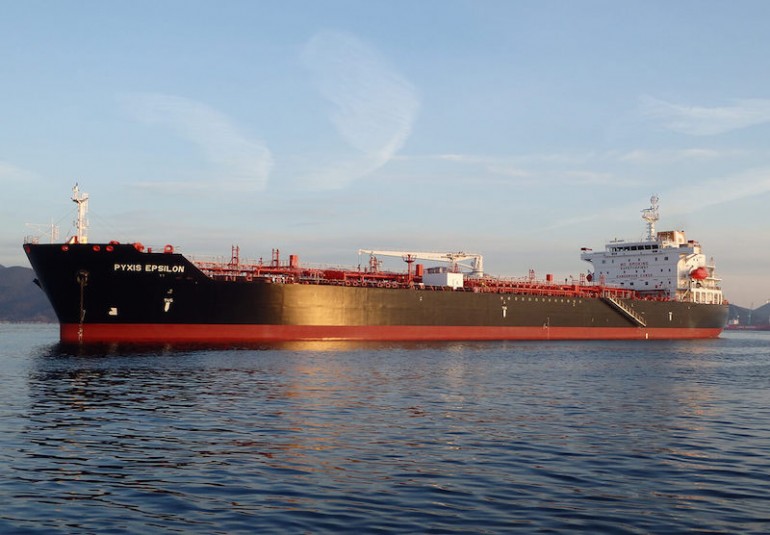
Pyxis Tankers, an international diversified shipping company, announced unaudited results for the three and nine month periods ended September 30, 2025.
For the three months ended September 30, 2025, our revenues, net, were $9.7 million. For the same period, our time charter equivalent (“TCE”) revenues were $8.9 million, a decrease of $2.7 million, or 23.5%, over the comparable period in 2024. Our net income attributable to common shareholders for the third quarter ended September 30, 2025 was $1.2 million, compared to net income of $3.6 million for the same period in 2024. For the third quarter of 2025, the net income per common share was $0.11 basic and diluted compared to a net income per common share of $0.34 basic and $0.31 diluted for the same period of 2024. Our Adjusted EBITDA for the three months ended September 30, 2025 was $4.2 million, a decrease of $2.5 million over the comparable period in 2024. Please see “Non-GAAP Measures and Definitions” below.
Our Chairman & CEO, Valentios Valentis, commented:
“Improving markets support our results
We reported results for the third fiscal quarter, 2025 with revenues, net of $9.7 million, Adjusted EBITDA of $4.2 million and net income per common share of $0.11. In comparison to 2024 market conditions, recent quarterly results were largely impacted by a $2.7 million decline in TCE revenues.
As 2025 progressed, the product tanker sector has experienced healthier charter rates, supported by resilient global economic activity and continued trade disruptions caused by major armed conflicts and geopolitical conditions. For the quarter ended September 30, 2025, our MR tankers generated an average TCE rate of $21,085 per day, which increased about $400 per day sequentially from the second quarter of 2025, but 29% lower than the exceptional industry conditions of the third quarter of last year. As of November 20, 2025, our MRs were employed at an average estimated TCE of $20,700 per day, with 93% of our MR available days booked in the fourth quarter ending December 31, 2025. Given ongoing market uncertainties caused by unprecedented geopolitical events and moderating macro-economic conditions, we continue to employ our fleet of three modern, eco-efficient MRs under staggered short-term time charters.
In the dry-bulk market, chartering conditions have improved noticeably since the summer of 2025, sustained by worldwide demand for key commodities, led by China. For example, the Baltic Dry Index has risen by 48% from June 30 until November 17, 2025, a solid indicator of better market conditions. For the quarter ended September 30, 2025, our three mid-sized bulkers generated an average daily TCE rate of $13,513 which increased about $700 per day sequentially from the second quarter of 2025, but slightly lower by 2.4% compared to Q3 2024. As of November 20, 2025, our bulkers were employed at an improving average estimated TCE of $17,150 per day, with 78% of available days booked in the fourth quarter ending December 31, 2025. All of our dry-bulk carriers are currently employed under short-term time charters.
Guarded optimism despite various uncertainties
For the near-term, we expect the chartering environment for both product tankers and the dry-bulk carriers to remain firm. Global demand for seaborne cargoes including a broad range of refined petroleum products and dry-bulk commodities is expected to post modest growth through 2026. While worldwide economic activity has shown resilience in the first nine months of 2025, the unpredictable trajectory of tariffs, sanctions and policy shifts may continue to weigh on global trade, contributing to inflationary pressures, increasing unemployment and ongoing dislocation of supply chains. However, surprising positive developments may occur. For example, increasing severe sanctions against Russia by the U.S. and EU as well as damages caused by Ukrainian drone attacks on Russian refineries may further alter cargo volumes and trade routes, re-new the expansion of cargo ton-miles as well as create arbitrage opportunities in various consuming markets. As refinery maintenance programs wind down this fall and we move into the stronger winter season, crack spreads remain healthy. The accelerated return by OPEC+ of another 0.4 million barrels per day (Mb/d) of crude oil production in the fourth quarter, 2025 on top of the return of all of its voluntary cuts of 2.2 Mb/d earlier this year, offer further signs of a well-supplied market.
Historically, demand growth for many refined petroleum products and dry-bulk commodities has been reasonably correlated to global GDP growth. In October, the International Monetary Fund revised its annual global growth forecast to approximately 3.1% through 2026. On the supply side, vessel deliveries are anticipated to increase through 2026 amid continued low scrapping activity. According to Arrow Shipbrokering Group (November 4, 2025), the MR orderbook stood at 294 tankers, or 15.2% of the global fleet, while 319 MRs, or 16.5%, were 20 years of age or older, creating a large pool of scrapping candidates and contributing to a more balanced long-term tanker supply outlook. On the dry-bulk side, fleet growth for the remainder of 2025 and next year is expected to outpace modest demand growth. However, potential scrapping and slow-steaming of a large number of older, less efficient bulkers could potentially mitigate challenging chartering conditions.
Given the high degree of macroeconomic and geopolitical uncertainties, we will continue to maintain a prudent and disciplined approach to operational and financial management. However, we believe there will be compelling growth opportunities in the near future to expand our fleet of mid-sized, modern eco-efficient vessels in both the product tanker and dry-bulk sectors. The closing of debt refinancing of two of our tankers in December 2025 will increase available cash by an incremental $10 million, which combined with our hunting license loan facility of up to $45 million, will enable us to promptly fund the possible acquisition of at least 3 vessels by January, 2027.
Lastly, we believe our current share price does not reflect the value proposition of Pyxis Tankers, let alone the significant operational progress, financial performance as well as future prospects. We continue to trade at a substantial discount to our peers based on standard industry valuation metrics, including price to net asset value. Consequently, the Board of Directors has authorized a new common stock repurchase program of up to $3.0 million through open-market transactions for a period of up to one year.”